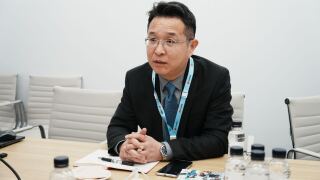
Scott Durchslag: untethering the desktop and putting Skype in your pocket, but the move challenges mobile operators on their call rates
In potentially its biggest challenge yet to mobile operators, Nokia is to start shipping its N series phones preloaded with Skype internet telephony software.
Owners of the new phones, due to be available from the third quarter of 2009, will be able to make free calls to other Skype users worldwide and cheap calls — undercutting operators' rates for conventional mobile calls — to any other phone number worldwide.
In an interview with Global Telecoms Business at Mobile World Congress, Skype COO Scott Durchslag said this marked the latest phase in a three-phase strategy to make the IP telephony system available to mobile users.
"Nokia will be starting with the N series, and the N97 will be released with Skype in Q3," says Durchslag. The phone will use the user's Skype address book as its standard contact list — thus presenting customers with the alternatives of a cheap Skype call or a more expensive GSM call to the same contacts.
The address book will also include presence information, says Durchslag, allowing N97 users to see which of their contacts are available via Skype at any time.
Skype and Nokia are keeping quiet about the financial commitment each side has made in the development, or about any revenue share.
"This shows we're very serious about mobile," he tells GTB — though he accepts that this has been after considerable delays. "We're catching up. We didn't make the progress we intended."
Phase one of Skype's strategy was to make the software available for a number of mobile operating systems, including Windows Mobile and Google's Android. The Nokia deal marks the beginning of phase two, with the software preloaded and available in phones over shop counters.
"Phase three involves the operators," he says. Skype has a longstanding deal with Hutchison's 3 to put the system on phones for its networks in five European countries — Austria, Denmark, Italy, Sweden and the UK. This has given 3 access to "a totally different segment of users", he says, and they are "people who talk more".
Durchslag is a relatively recent appointment to Skype, having joined in July 2008 — to report to company president Josh Silverman, who himself has been there only since March 2008.
Both their appointments seem to be part of a significant shake-up of Skype, which was founded in 2003 by peer-to-peer enthusiast Niklas Zennström and bought by eBay two years later for the remarkable price of $2.6 billion. Since then, it's fair to say, Skype has not lived up to whatever expectations eBay may have had for it.
Durchslag is a former McKinsey consultant who had seven years at Motorola before joining Skype, first as chief strategy officer for its personal communications sector — a period which saw the company briefly revive its mobile handset fortunes with the Razr — and then as general manager of South Asia followed by a time as corporate vice president for global product and experience invention.
Skype is, of course, mainly a peer-to-peer voice over IP network that offers free global voice and video communications to computer users via their internet connection. The software has been downloaded 400 million times, though the average usage rate remains low.
However the company has some revenue-earning business models. Back in the Zennström era, it launched SkypeIn, by which users could pay for a regular virtual phone number so that ordinary mortals could call them, and SkypeOut, so that users could pay to make calls from Skype to fixed and mobile phones worldwide at rates that compete with other VoIP providers.
Under the new management, though, Skype is developing some new services. As this issue of Global Telecoms Business went to press, the company gave first details of a new programme for business users, though it is still in beta phase.
This new move marks a further change for Skype: for the business service, it is moving away from the peer-to-peer technology that Zennström and his colleagues developed at the start of the decade and moving to industry-standard SIP techniques — as used by most other VoIP providers.
Skype telling potential customers: "With Skype for SIP Beta you simply make and receive calls with Skype using the SIP protocol that many phone systems support natively."
But it is integrating that with its existing system, so that Skype SIP users can still connect with the rest of the Skype user base. "And all of this can be implemented without any expensive upgrades of your existing telephone infrastructure," Skype enthuses. Users will need a SIP-enabled PBX that supports the G.729 codec in order to join the beta programme.
This, along with the Nokia announcement back at Mobile World Congress in Barcelona, shows a more aggressive, more business-like Skype is emerging onto the market — something that rival operators would do well to take notice of.
The Nokia deal is "a major strategic partnership", says Durchslag. It will start with the N97 but will be "broadening from there", he says. "We're extremely excited about this. It's our engineers working with their engineers to do a pretty deep level of integration, down to the address book."
So a user's standard Skype address book becomes the address book of their Nokia mobile phone. "For Skype users that's something close to Nirvana," he smiles.
What will the operators think of that? "I think you'll get mixed reactions," says Durchslag. "Some of them will be quite open to it, because we've had some pretty important successes with 3 and it ended up being much more of a positive than a negative to 3, and that's getting to be understood in the industry."
Others "won't want it", he admits, and "Nokia will make decisions about what ships where".
But Nokia ships 400 million devices a year "and a good proportion of those are going to markets where the operators aren't buying phones", he notes. In other words, they're not subsidised. Customers simply buy SIM cards from their chosen operator and source their own phone. The operators have limited control over the handsets in use.
"That's important for us," says Durchslag, "because in those parts of the world probably the primary way that people will access the internet is through a mobile device, and we have a lot of Skype users in those parts of the world."
For them to be able to use Skype through a Nokia device "is a real win-win", he says: "For Nokia it differentiates their devices in those parts of the world, and they're already very strong and have great distribution and a strong brand. Bring that together with the Skype brand and the Skype experience and that's a pretty special combination."
And Skype users have been asking for ways to take the service mobile, he adds: "It's the number one request we get from them. And it will help us get more users. We're always looking for where our next 100 million users come from. We have to be thinking about that."
Skype's main revenue source is through people making calls using SkypeOut, he says. "The more places you can use Skype and have Skype-to-Skype calls, in general the more SkypeOut revenue comes with that."
So Nokia users will be able to make SkypeOut calls. Skype charges around $0.021 plus tax per minute for calls to a wide variety of places around the world, irrespective of where the Skype user is at the time: Argentina, Australia, China, Malaysia, Poland and the US are all included in that tariff band — which is a tiny fraction of the international rates typically charged by mobile operators.
Of course, Skype users will have to pay data charges to make calls over mobile broadband connections, but the total cost will still undercut mobile operators' rates.
"We're trying to do some co-creation here," says Durchslag. "We want to create the next level of mobile Skype experience." It's all about "untethering the desktop and putting Skype in your pocket".
And it's "multi-modal", he adds: not just voice calls, "but there's a lot of chat that people are doing as well", using Skype's equivalent of instant messaging. "The chat community is extremely active." There's a "zone of co-creation" with the Symbian software that Nokia uses for its phones, he adds.
"We don't have all the answers ourselves, but who better to work with to do that than Nokia — by far the biggest mobile phone manufacturer in the world."
Durchslag is wary about revealing insider information about Nokia's plans to extend Skype beyond the first N97 later in 2009 — and neither company has made any follow-up announcements since the Barcelona conference.
"We have an expectation that this is going to deliver tens of millions of Skype experiences," he says. "We'll be working together to figure out where and how are the best ways to do that. But the final decision sits with them."
It's clear that this is a powerful Trojan horse for Skype and Nokia, and one can understand why operators are — though not yet publicly — seething. "Say you and I are in each other's Skype address books, and on the Nokia phone there are also some other numbers," says Durchslag. The phone "will give you all that information in one integrated place and then you click where it is you want the call to come from, Skype or cellular. For us it's all ultimately about consumer choice."
Who would choose to make a call to a friend or colleague at $0.50 a minute when, just alongside in the address book, there is a free Skype-to-Skype alternative or a SkypeOut call at little more than $0.02 a minute?
And, while it's not quite clear yet — Durchslag was not wholly committal — it seems as if the friend or colleague contacted via a SkypeOut call would see the caller's own SkypeIn number. So a return call would earn your mobile operator little revenue.
No wonder operators are shocked by Skype's and Nokia's bold moves. It's potentially offering the mobile industry more competition than EU commissioner Viviane Reding ever did. GTB