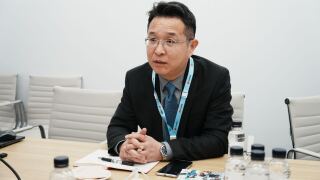
Franco Bernabé: The industry needs young, motivated,
professional people who understand the challenges
ahead and are willing to take them on
Franco Bernabè, the chairman of Telecom Italia and of the GSM Association, came to present the GTB 40 under 40 with their certificates. “Telecoms is one of the industries where, if you are young, you are better equipped to understand the challenges that affect the industry,” he told them. “In other industries the reverse is true. I spent most of my life in the oil industry and we’d be having an event for the 60 over 60.”
The last three decades have been a very successful period for telecoms, he said. “We need to recognise things have been changing and we need to recognise the strategies we have to follow.”
The conference explored those strategies and the need for telecoms to redefine its role. Jeff Heenan-Jalil, vice president and head of the telecoms equipment vertical at Wipro Technologies, said: “The time pressure being put on us is intense. We believe there will be only one network, it will be converged and connected. The question is how scalable it will be. I’ve just got back from China and China alone will dwarf the numbers.
“In the last ten years, I’ve seen quite a dramatic shift from ten years ago,” he added. “When I was at Lucent Technologies, I thought we were the innovators of the industry. Today the enterprises and the end users define the demand.”
Heenan-Jalil said the top five vendors in 2000 were Lucent, Ericsson, Nortel, Alcatel and Nokia. In 2011, the top five are Cisco, Ericsson, Huawei, Alcatel-Lucent and Nokia Siemens Networks, hotly followed by ZTE. Employee numbers at equipment vendors have declined 24%, revenues have declined 31% and investment in research and development has fallen 25%.
Heenan-Jalil’s opening presentation was followed by a discussion between consultant and thought-leader Martin Geddes with Chong Siew Loong, head of network systems at Nucleus Connect, the world’s first open access network.
Chong explained how the Singapore government has established a S$1 billion fund to establish a network company and an operating company to establish the country’s open access network. The network company received a tender to build passive infrastructure to all businesses and homes.
No wholesale discount
Nucleus Connect won the tender to operate the pipe into homes and buildings and non-building address points. “If you think of it as a water network, the network company builds the pipes and the operating company is the pump,” explained Chong. “We sell wholesale bandwidth to providers at a wholesale price that is published on the internet. Regardless of whether you buy one or 10,000 you pay the same price: there is no wholesale discount. Our goal is to bring very low cost bandwidth to the home.”
Geddes explored the changing role of voice amidst the deluge of data traffic. Voice revenues are far from over for operators, in spite of Skype, other VoIP providers and bundling. “What people are most willing to pay for is a sense of being there with somebody else,” he explained.
“Voice provides that rich sense, that deep psychological need. It’s a beautiful illusion that kind of works. Companies are starting up to serve all kinds of unserved markets for voice and voice is becoming increasingly embedded into business processes.”
Operators will need to raise their game if they are to continue to hold on to their voice supremacy.
Mounir Ladki, vice president and general manager of Mycom, explained how operators will have to continue to make heavy network investments over the next few years in response to exponential growth of data traffic.
Mobile data traffic, he said, is expected to increase by a factor of 30 in the next five years to reach more than 8 exabytes a year by 2015. Video will be at the heart of that and operators will need to base their network investment scenarios on assumed usage of two gigabytes a month per user.
“Today we are at a turning point in the industry as the telecoms operators have to adapt to and find the right models in order to find a level of profitability that they were used to in the last decade,” he said.
Connecting the unconnected
The second day of the event began with a presentation from John Finney, chief commercial officer of O3b, which is building an innovative satellite network to address the unconnected. O3b stands for “other three billion” — the unconnected.
Finney explained how novel approaches are needed in emerging markets in order to bring services to low income markets. It is possible, he said, provided the dogma of network construction and technical innovation is put aside. “Doing more means increasing the amount of innovation you offer to the poorest parts of the world, not sacrificing innovation for price,” he said.
Reverse innovation and Gandhian engineering are the approaches that will enable that in emerging markets. They won’t get the free internet that the developed world received. “I’m talking about the bad decisions of the 1990s made by the people responsible for the bankruptcies that followed” from long distance cable roll out. “Most of that infrastructure went through Chapter 11 and was sold back for five cents in the dollar. It is a donation to the world that has kept the internet free,” he added. “Emerging markets aren’t going to receive that same donation.”
The O3b system launches at the end of next year and one third of its capacity has been sold.
Norman Moyo, the chief commercial of Tanzanian operator Zantel, and Hajo van Beijma, co-founder of Text to Change, discussed m-health and its application in developing markets.
Van Beijma explained how his organisation is working in Africa and South America to bring health-related information to unaddressed populations. “In London if you want to know where a clinic is you can instantly get that information and it’s free,” he said. “Those services are not available in most of the developing world.”
Moyo sees an untapped revenue stream in m-health. “Particularly for Africa, m-health is a virgin area,” he says. “We are beginning to develop models that are profitable in m-health,” he said. “Who gets an ECG, who has a regular blood test? One per cent would be lucky. We are beginning to see a huge opportunity and, as operators, we need to decide how we start mining this opportunity.”
Blood pressure monitor
He gave the example of a device costing about $2,000 that monitors blood pressure and takes a variety of health readings and then sends them to a system. “As an operator, if I put 1,000 machines in our shops, health facilities and other locations in Dar-es-Salaam users can come in for health checks and I’ll charge for this through M-Pesa,” he said. “You have to remember that going to see a doctor costs maybe $10 for transportation, $20 for the consultation — and I can sell this service for $5.”
A panel discussion followed discussing how to connect the unconnected. Aircel’s Pankaj Agrawal commented on his home market. “If you look at the Indian phenomenon, in the last one and a half years there has been a major roll out of 3G technologies and operators like us are doing field trials of LTE so whole lot of capex has gone [into the market],” he said.
“In any circle, we have 13 or 14 competitors, there are extremely low tariffs and huge capex has gone into it. That’s a huge ROI challenge but within 15 or 16 years we have achieved more than 100% penetration in metropolitan areas. Incoming calls are free and outgoing calls are near free — we have the lowest tariffs in the world.”
That’s in metropolitan areas, though. Bringing the same services to rural areas presents a significant challenge. Udit Mehotra, director and chief marketing officer of VNL, an Indian operator addressing rural markets, is focused on that.
“We focus on how to extend communications to non-urban areas,” he said. “Infrastructure costs rise as you move out of the urban areas so it’s nearly impossible for an operator to make money.”
Ryan Sher, chief operating officer of WIOCC, set up by 14 African operators to build the EASSy submarine cable on the continent’s east coast, faces different challenges. He’s bringing massive submarine infrastructure to the east coast for the first time and, while the project has investment from operators and the World Bank, it is transformative to the African market.
Leapfrog technology
“Using broadband is a cost prohibitive factor,” he said. “Even in South Africa most people don’t regularly use broadband applications. This is a leapfrog technology, our subsea cables are the latest technology. We use 4.8 terabit cable which is more capacity than Africa will need for a long time but a step change is coming.”
Erwan Ménard, chief commercial officer of Data Direct Networks, introduced the concept of big data. He talked about the massive scale of data creation citing Google’s Eric Schmidt’s comment that between the beginning of the world and 2003, five exabytes were created. Now Schmidt says we are producing five exabytes every two days.
That presents an opportunity for ICT companies, said Ménard. We can’t necessarily use all that data now but it needs to be stored for a future time when sense can be made of it and use extracted from it. Even now, there are plenty of opportunities to use the data we hold more effectively.
“We need to move from consuming very structured information into consuming unstructured information to get the intelligence out of it and turn it into actionable intelligence,” he said. “Storage is now a strategic enabler and the big opportunity is really for the ICT industry with big data, operators have a choice whether to play or not.”
Big data is just one of the many opportunities transforming operators’ profit potential. Advertising has long been seen as a means to create revenues to offset network costs. Alex Franks, UK managing director of Blyk, a provider of mobile advertising, partnered with Orange in the UK in 2009 and now provides opted-in, advertising-related offers and bonuses to 1.2m Everything Everywhere customers.
Opportunities include search-related advertising, web display advertising, application display advertising and advertising in messaging. Franks thinks messaging is particularly attractive for operators. “That’s an interesting one for operators because they own that pipe,” he added. “It’s a particular area where operators can make a stand and take that market.”
Infrastructure change
Super-fast broadband and super-fast services present both great challenges and significant opportunities for operators. “The biggest problem we have is the hump of infrastructure change,” said Sian Baldwin, vice president of indirect channels and partners at BT Global Services.
“In urban areas we can upgrade from technology to technology and go faster but in rural and non-urban areas it’s more of a challenge. You end up being stuck in the difficult position of being a lowest common denominator. How do you run a service when you might have lower bandwidth in one service than another.”
That’s a pertinent question, especially as new services, many of which require vast and reliable bandwidth, proliferate. Cloud services are on everyone’s agenda and Dor Skuler, vice president of cloud solutions at Alcatel-Lucent, sees them as an opportunity to enable operators to move from being simply an IP pipe to providing a blended service pipe.
“We have to be elastic in the way we sell services,” he said. “We currently sell 200 million gallons of Cherry Coke in advance and two years later you [operators] sell it drop by drop. There’s a disparity in the revenue model and it takes a long time to launch a new service.”
Bernabè concluded the summit with a call to arms: “We are too much engaged in defending ourselves against all the rigid approaches to net neutrality. We need to go back to the tradition of the industry which is not best effort. The objective of the industry for nearly 150 years has been to provide reliable services and that is not compatible with extending the concept of best effort [internet] to the rest of the industry,” he said.
“The stock market thinks the battle has been won by the web companies. I don’t think so. I don’t think the future is in the hands of Apple and Google and our business will be taken away and we will become dumb pipes. Going towards a cloud environment, we will regain perhaps not supremacy but a very strong competitive edge against other players.
“At some point we will be back in the driving seat,” he concluded. “The market may need some concentration but that’s not the challenge. The challenge is what kind of architecture will drive us back to the centre of the stage of the ICT industry. That’s why we need people like you: young, motivated, professional people who understand the challenges ahead and are willing to take them on. Telecoms is not the boring industry the financial markets often tend to portray. Joining the telecoms industry is the most exciting thing I did in my life.” GTB
The summit included a round table on the theme Should operators still view customers as something they own? There is a report of the round table here.
More pictures from the summit