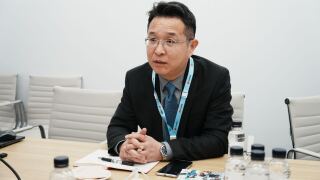
Byun Jae Woan: It’s our destiny to use heterogeneous
networks, licensed and unlicensed. It’s a matter of how to use
them cost-effectively
Korea’s SK Telecom had more than a million LTE subscribers at the end of January 2012, and expects six million by the end of this year.
If the company achieves that target, 23% of the company’s current total of 26 million subscribers will be using the 4G technology.
It won’t be quite that percentage because, says company CTO Byun Jae Woan, one third of SK Telecom’s LTE subscribers are new customers. “They’ve churned over to SK Telecom from our competitors,” he says. “They chose LTE. With LTE, customers feel the difference from [3G technology] HSPA. We launched LTE earlier than planned in July 2011 and we had more than a million subscribers by January, and we are expecting six million by the end of the year.”
The new LTE customers are already heavy data users — carrying about 6% of SK Telecom’s data traffic, about 50% more is used by 3G customers. LTE customers are downloading 1.6 gigabytes a month on average, compared with an average of 0.95 gigabytes for 3G smartphone users on the company’s network.
LTE customers are charged different prices according to whether they want to consume 350 megabytes up to 10 gigabytes each month. Prices go up to 120,000 won — $106 — a month for the full 10 gigs. A more modest package of three gigs a month costs 34,000 won, or $30. “That’s the most popular,” says Byun, who has been with SK Telecom since 1983. He also heads the technology innovation centre at SK Holdings, the parent company which owns businesses in energy, pharmaceuticals, IT and transport.
“We see a much higher data usage among our LTE customers — especially the early adopters. Customers are paying $10 a month more than average customers.” In the long term he expects that difference to reduce, so that in time LTE customers will pay about $5 a month more than 3G users.
Multimedia downloads
The company’s research shows that multimedia files already account for more than 70% of traffic on the network. “It’s mostly downloading media files. People are sharing video clips and sending material to their friends. Customers’ behaviour is changing. More and more people are sharing multimedia,” he says. The company has recorded an extraordinary 39-fold increase in data traffic in one year across all networks together.
SK Telecom, like other operators, is looking for ways to overcome the problem that data is causing to their mobile spectrum and the backhaul networks that connect base stations to the rest of the telecoms infrastructure.
Even thought LTE users are consuming more data, the roll-out of the LTE network is helping, says Byun — because as the new network takes more traffic, “this gives breathing room for our 3G network”. In addition LTE is more efficient in the way it uses radio spectrum to carry information. “The spectral efficiency is three times higher that 3G.”
But SK Telecom is coming to a similar conclusion to other operators: that it needs to offload data to wifi networks whenever possible. “What we plan to do is use unlicensed wifi. Customers love wifi and it’s fast,” says Byun. There is wifi “in areas like cafeterias and school campuses, and buildings are deploying wifi with their own money”.
At Mobile World Congress in Barcelona in February, where Global Telecoms Business interviewed Byun, the company demonstrated a hybrid network technology that seamlessly integrates LTE and wifi, giving speeds up to 100 megabits a second.
The company also plans to launch — in the second half of 2012 — a hybrid network that brings 3G and wifi together, at rates up to 60 megabits a second.
Both of those moves address the need to find extra spectrum. Backhaul isn’t the problem in Korea that it is for some mobile operators, says Byun. “It’s a serious problem for European mobile operators but Korea has the most advanced optical infrastructure.” Another member of the SK group, SK Broadband, provides the company’s backhaul services. “The infrastructure is there,” he says — though of course SK Telecom has to pay the operational expenses to use it.
Low-power cells
In the long term the company is looking at the use of smaller cells as a way of increasing capacity and improving the efficiency with which spectrum is used. One traditional large cell uses spectrum over a wide area of a city. Dozens of low-power cells in a closely coordinated network can each use the same spectrum again and again.
“We have to design new base stations, to connect smaller cells,” says Byun. He and his colleagues are designing a system with a number of radio units — essentially small antennas — circling a central system called a digital unit, “a big amplifier that sends radio signals to the RUs”.
One DU will run up to 18 RUs, but the design makes it possible to stack eight DUs together in one location, “so that 144 cells can be controlled in a coordinated way” by what’s essentially a central office.
Coordination is vital, because vendors and operators are recognising that interference at the boundaries of cells is a problem with LTE. “The network capacity of LTE depends on reducing this interference.”
The company is calling this technology CoMP, or coordinated multi-point. It is “a technology that prevents base station interference and abrupt call disconnections in coverage boundary areas by enhancing signal strength, the lack of which leads to significant drop in data transmission speed”.
SK Telecom is working on this project with Samsung, which already provides about half of SK Telecom’s LTE network, including in the area around the capital, Seoul, where a quarter of South Korea’s population live. Ericsson and Nokia Siemens Networks share the rest of the LTE infrastructure, says Byun.
Samsung is working exclusively with SK Telecom on the project but “it will later be available to other operators”, says Byun. “We’ve already commercialised it.” Samsung “became the first to implement” the design. “We haven’t agreed yet” with Ericsson or NSN, he adds.
As a result of the coordinated design “we have improvement in the performance at the edge, which is subject to interference. The central office sends information to control unwanted interference.”
Those radio units each cover about a kilometre, but SK Telecom is also working on femtocells, which it is calling “LTE hot zones”, incorporating LTE and wifi in the same unit. The aim of this technology is to minimise shadow areas, especially inside buildings.
“Customers will be able to experience a data service of much greater quality, speed and stability.” The company hopes to commercialise these products by the middle of 2012 for use in homes and office buildings.
The company is sourcing its combined LTE and wifi femtocells from three Korean companies, including group member SK Telesys. “We’re deploying the system in July,” he adds.
Hybrid networks
The hybrid network is an essential part of the company’s strategy. “It’s our destiny to use heterogeneous networks, licensed and unlicensed. It’s a matter of how to use them cost-effectively.”
The company “has the technology to send traffic over heterogeneous networks”, he adds. “The handset will automatically allow traffic to go over those networks in parallel. We’re just at the beginning.”
Won’t it be a problem to persuade people to buy terminals to work with this sophistication? SK Telecom doesn’t see this as a challenge. “In Korea customers change their handset every two years,” says Byun. “It’s not just a handset. It shows someone’s social status. People willingly replace their handset with a new one.”
Already 80% of new customers choose a smartphone, he adds — and of them 48% opt for 3G, with the other 32% going for LTE.
The company already offers handsets from Samsung, LG and HTC. “We have seven LTE handsets available now, but by the end of the year we will have 15 new handsets.”
SK Telecom still has a 2G network, running on CDMA technology. “We’ll keep it as long as we just cover the operational expenditure,” says Byun. “The network is working very well for low-tier voice customers.” The company has seven million 2G customers, he notes.
At some point the company will look at refarming some of its 2G and 3G spectrum for LTE services. “That is an important business decision, but there is no need for us to make that decision yet. In fact it won’t be difficult to integrate WCDMA and LTE in the same spectrum.”
The company has asked its LTE customers why they chose 4G technology. “We found that 54% said they want LTE quality,” says Byun, “but 32% chose it because they want a chic handset.”
Be that as it may, he is already looking out for potential problems with hybrid handsets that cover wifi as well as LTE technology. “One problem with wifi is that it consumes more power,” he says. Wifi terminals spent a lot of time hunting for signals, and that uses power. “Customers will experience battery problems. That’s a technology issue to solve and we have to figure it out.”
A bigger battery is no answer, as that would make a less-than-chic bigger heavier phone. “We have to find a solution. We want to leverage our expertise in low power consumption in cellular technology and apply this to wifi technology. We want to make this part of the strategy. But there is a trade-off between power and bandwidth.”
But these are challenges the mobile industry has been tackling and solving since the first customers turned on their mobile phones to tell their families when they’d be home for dinner. There have always been challenges — and these challenges have been solved time and time again. GTB
Further reading from Global Telecoms Business:
SK Telecom buys 21% share in Hynix 15 Feb 2012
SK Broadband to expand overseas units 09 Jan 2012
SK Telecom gets OK to buy chip firm 28 Dec 2011
SK Telecom applies for spectrum licenses 29 Jul 2011
SK Telecom plans fast roll-out of cloud-based LTE 25 Mar 2011
end